Craig and Sal Go Global
Varanasi, India
December 18, 2012
It’s a two day journey from Pokhara to Varanasi. We decided to break up our trip in Lumbini, the birthplace of the Buddha, near the Nepali-Indian border. After a long nine hours of Nepali public transport we arrived in Lumbini. Lumbini ended up being a bit of a disappointment for us – the Buddhist temples are all spread out in a huge ugly park almost 6km long.
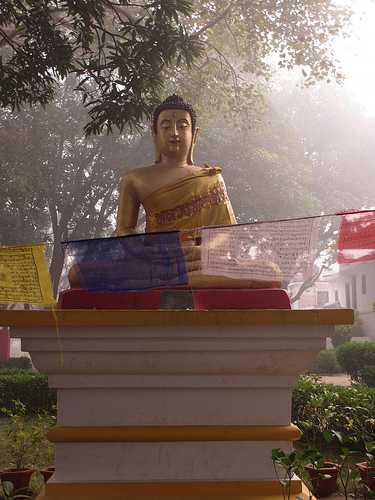
The next day we headed for the border town of Sunauli. Lonely Planet accurately describes the town as “a dusty hell hole”. The border is a very busy place and, as Indian and Nepali people are allowed to cross freely, there are no gates or barriers. So, missing the small immigration office on the side of the road, we managed to accidentally cross the border into India illegally! Upon realising this, we quickly backtracked into Nepal and got our paperwork in order.
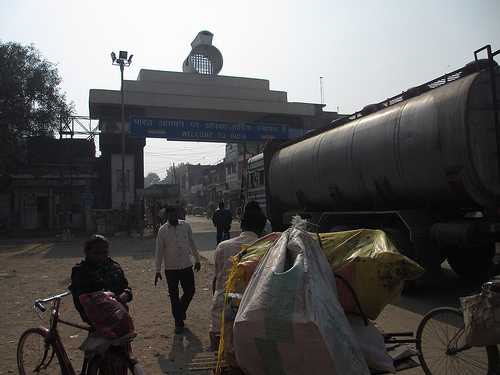
From Sunauli we had a three hour bus ride to Gorakphur, the closest city on the Indian rail network. The afternoon was getting on, so we decided to stay a night in Gorakphur and catch an early morning train to Varanasi.
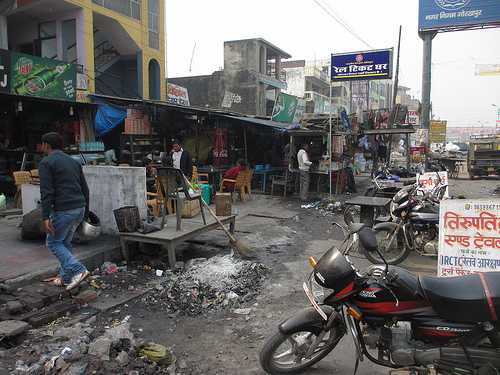
The city wasn’t the best introduction to India. It seemed that picking the fanciest hotel by the train station just meant we got the smallest cockroaches – we saw some truly filthy rooms when we were deciding where to stay. Walking along the street meant having to avoid stepping in piles of burning rubbish, mud, and a variety or human and animal wastes. We were eager to escape early the next morning but unfortunately our train was delayed, stranding us in Gorakphur for seven extra hours. Adding to our great mood, someone tried to tug Craig’s wallet out of his pocket at the train station. Welcome to India!
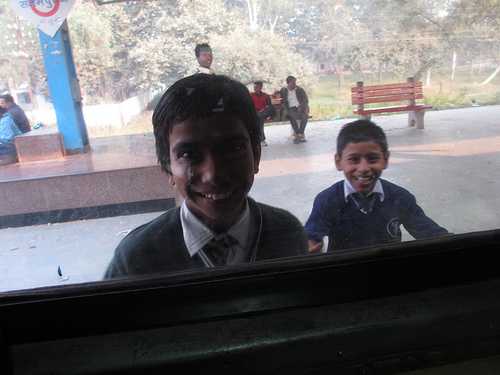
Things improved immediately upon boarding the train. We had pulled up at a station along the way, when some curious school kids on the platform spotted us and came up to the train window to peer in. They were really cute, just staring and giggling, and they even called their friends over to have a look!
We were picked up in an auto rickshaw from the Varanasi railway station. The 15 minute ride to our guesthouse was to be the scariest ride of our lives. It was like a car chase in an action movie, with our driver madly overtaking and swerving away from oncoming traffic a moment before impact. We even “nudged” a couple of cyclists along the way. Being our first rickshaw ride in India, we didn’t know if this was normal. So we hung on, stunned, not asking him to slow down. We later realised that, while driving is chaotic here, our driver was particularly crazy and aggressive. It was a relief to arrive alive to the refuge of a nice guesthouse.
Varanasi is an ancient city located on the banks of the Ganges, a holy river for Hindus. The city is known mainly for its ghats: terraces leading into the Ganges that are used for bathing, washing clothes, launching boats and cremating bodies. The main tourist activity in Varanasi is simply to wander along the ghats watching daily life taking place. We saw a Bollywood music video being filmed, pilgrims bathing, kids flying kites, spiritual gurus, buffalo herders, wedding processions and boats full of women dressed in colourful saris.
We also saw two of Varanasi’s cremation ghats. If you’re squeamish, you might want to skip the next three paragraphs (don’t worry, there are no photos though). At first we thought the cremations were not as intense as we had expected. The first ones we saw were already underway – the flames engulfing fabric shrouds that were wrapped around the bodies. But then we saw the start of a funeral. First, the family lifts the shrouded body onto the stacked firewood. Then the eldest son sets a huge bundle of straw ablaze and runs three times around the funeral pyre before setting it alight.
By this point one of the cremation pyres we were watching earlier had started to burn unevenly and the shroud had burnt away at the head and torso. The man working at the ghat took a bamboo pole and, as if rearranging a bonfire, prodded the dead man’s torso into the hottest part of the fire. We were left watching the stiff body sitting exposed and upright, silhouetted by the fire. While this was obviously a very intense and foreign experience for us, it didn’t feel upsetting since we knew that this was a normal and respectful part of Hindu culture.
Some bodies that aren’t cremated are instead given a water burial in the Ganges. So if the sewerage and rubbish aren’t enough to put you off the idea of bathing in the holy river, it might do it to know that decomposing bodies occasionally wash up on the banks.
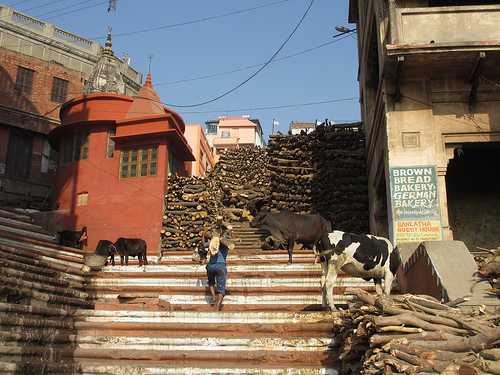
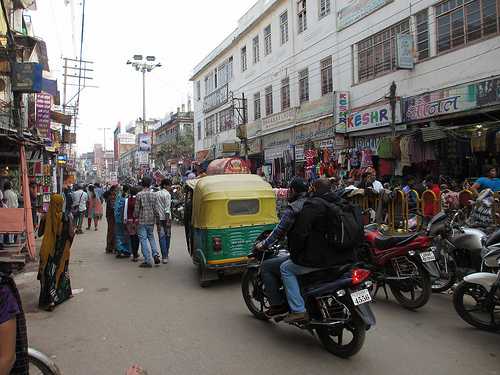
Unexpectedly, we found walking along the ghats to be quite peaceful, at least in contrast to the overcrowded and dirty alleys of the old city that lie behind the ghats. Despite the alleys being full of people and two metres wide at most, they still let motorcycles ride through (like Thamel in Kathmandu, but much worse). Once a cow appeared from around the corner, calmly pushed its way through a crowd of people and brushed right past us! We even saw two fighting cows bowl a man over at one point. It was always nice to reach our destination and get off the “streets”.
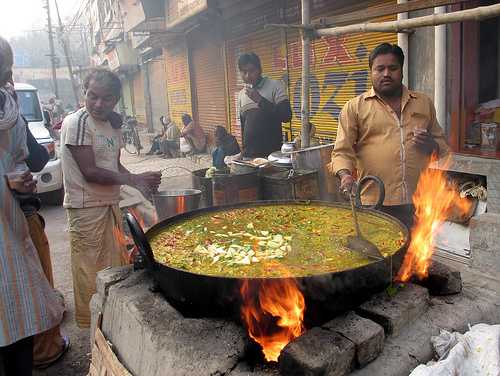
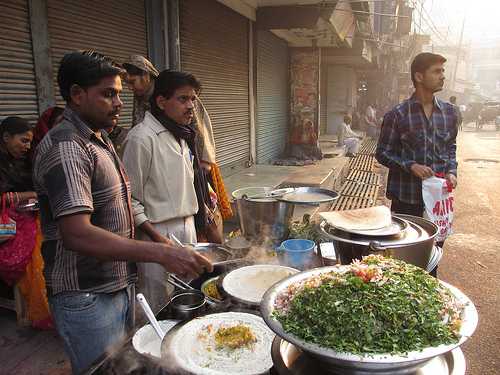
We weren’t able to CouchSurf in Varanasi, but we did spend an afternoon hanging out with a Varanasi CouchSurfer. He took us to a local street food vendor who has been feeding his family for over a decade. It was great having someone guide us through the Indian street food experience. We tried Gol Gappa (crispy shells filled with curried vegetables and a spicy juice), Aloo Tikki (spicy mashed potato and vegetables) and Paan. Paan is a mouth freshner, made from a concoction of dubious ingredients wrapped in a Betel leaf. The savoury snacks were delicious, but we ended up having to spit the Paan out. An acquired taste maybe?
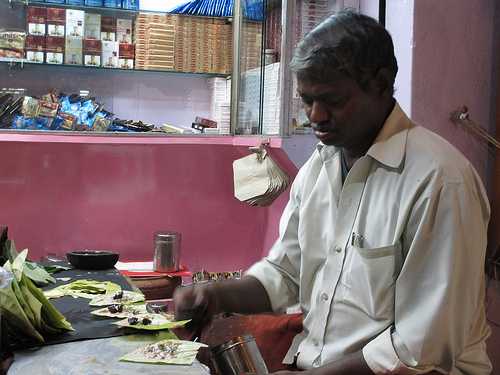 Making Paan
Our confidence with street food bolstered, we had lots of samosas (which are everywhere), desserts and dosa over the next few days. The going rate for a fresh, hand-made samosa is about NZ$0.10! We found we could have a veritable feast on the street and the bill would come to about a dollar between us. It’s dangerous to have no financial barrier to overeating, particularly when the food is so delicious!
So far there are three topics that invariably come up when we talk to locals about issues facing India: corruption, population growth and poverty. We learnt about the extent of corruption in the 2010 Commonwealth Games in Delhi – more than NZ$500 million was lost to corruption, which is up to 20% of the whole budget of the games!
India has 1.2 billion residents, and is set to overtake China as the world’s most populous country in the next couple of decades. Although India’s economic growth has been impressive, its population grows faster still, making it a struggle for the country to maintain (let alone improve) the infrastructure and standard of living.
As far as poverty goes, we’re finding it hard to process some of what we are seeing. Lying in front of the Gorakphur train station was a dirty, withered man lying slumped on the concrete. He lay there in an old shirt, naked from the waist down, his inert body riddled with a huge cloud of flies. Maybe we’ll have more to say in a future post.
The thing you hear most often about travelling to India, almost to the point of cliché, is that it is a place you both love and hate. This has been true for us so far. The vibrancy, food and incredible sights make India a really exciting place to be. On the other hand, we’re struggling with the dirtiness, ever-present pushy touts, lack of personal space and extreme poverty. Like in South America, we’re encountering lots of people willing to lie and cheat us in order to make some money. It can be hard to work out who is genuinely trying to help us and we sadly find ourselves sometimes becoming suspicious by default.
We found Varanasi to be thoroughly fascinating, but after three days here we’ll be happy not to be walking through the old city any longer! Probably time for a change of scene then, and it’s a good thing that we’re off to Agra next – home of the beautiful Taj Mahal.

Written by Craig Drayton and Sally Robertson