Craig and Sal Go Global
Berlin
November 06, 2012
One thing we noticed straight away about Berlin was how different it looks and feels compared to other European cities. The city was largely destroyed during WWII and the fragmentation of Berlin during the Cold War meant that East and West Berlin were rebuilt as separate cities, with two city centres and different architectural approaches. When the wall came down, huge tracts of land were freed up right in the middle of the reunified city. As a result, much of the city has a very modern look and there are several commercial hubs.
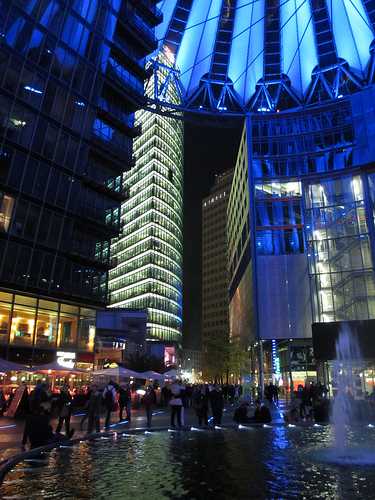 Berlin’s Sony Centre, opened in 2000 on ex-Berlin wall land
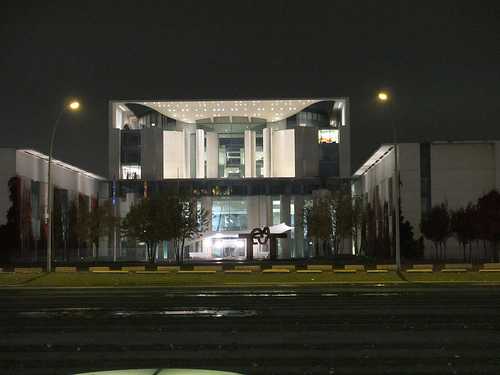 The German Chancellery building
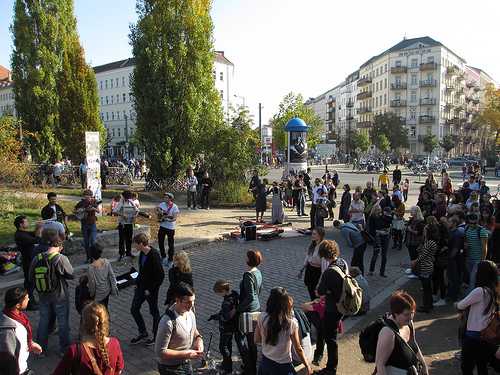 Buskers in Mauerpark, also ex-Berlin wall land, now the site of Berlin’s biggest flea market
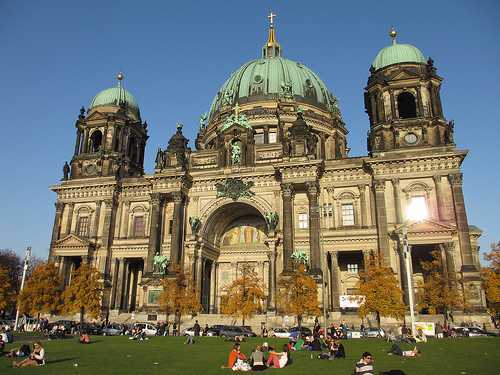 The Berlin Cathedral on “Museum Island”
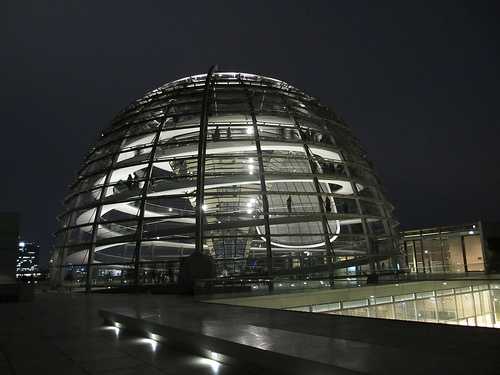
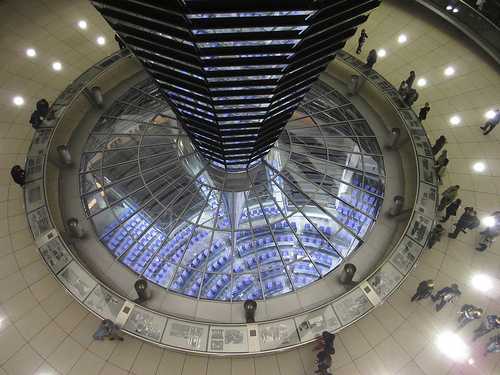
The Reichstag (German parliament) building fell into disuse while Berlin was divided. It was renovated to house the German parliament after reunification and this cool dome was completed in 1999.
We CouchSurfed for our five night stay in Berlin with our hosts Benni and Vera. We had a great time and we even got to play Carcassonne again and do some baking! One night we went out together to see the Berlin Festival of Lights, during which dozens of buildings and landmarks around the city are lit up with decorative lighting. Some of the installations involved creative video projection so that parts of the building looked like they were moving.[slickr-flickr tag=“Berlin-lights”]
Berlin has many museums to choose from. We continued our World War II tour of Europe, visiting the Jüdisches Museum Berlin (Jewish Museum), the Topographie des Terrors (an outdoor museum located beside a remaining section of the Berlin wall) and the Deutsches Historisches Museum (German History Museum). The German History Museum was one of our favourite museums so far. The museum provided a whole history of Europe (with a German focus) right back to 500 B.C. If that sounds overwhelming to you, you’d be right! We spent seven hours here (a record for us) yet we still had to miss out huge sections and left right on closing time.
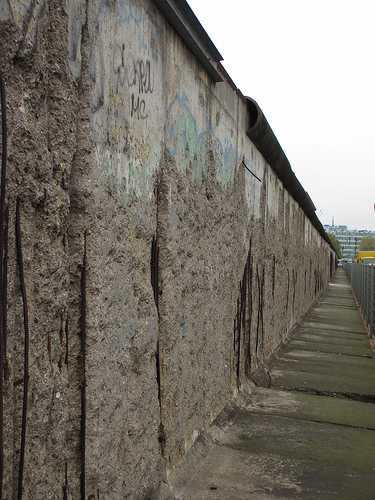 A preserved section of the Berlin Wall
The building of the Jewish Museum has been cleverly designed to reflect, through architecture, the difficult times of Jewish people throughout history. For example, the ground floor is sloped and has several pathways leading in different directions, creating a feeling of disorientation. You can read more about the building design here. The museum was great homework for us, given our next stop is Israel!
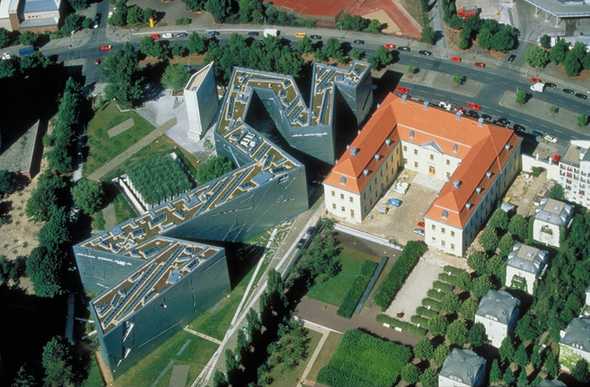 Jewish Museum Berlin. Source: Studio Daniel Libeskind (Architecture New Building)
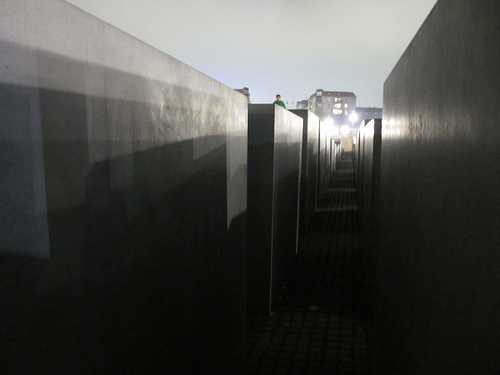 The Memorial to the Murdered Jews of Europe
As a break from WWII history, we went on a walking tour of Cold War era nuclear bunkers. On this tour we saw two very different bunkers. The first was an old Nazi air-raid shelter which had been converted into a fallout shelter. Let’s just say that this bunker was plagued with problems. For a start, the roof was too thin to stop bombs bursting through. Also, having no generator, the occupants would have to manually crank an air pump to stay alive. Before long, perspiration would be condensing on the ceiling and dripping down on people inside. But that would be the least of their worries as, supplies having been exhausted, they would have to leave the bunker into a radioactive wasteland after just 48 hours.

The second bunker was constructed especially for the Cold War and had a bit more going for it. With clever German efficiency this bunker was primarily a working subway station, but it had some key additions that allowed it to be used as a shelter. If the time came, big blast doors would close on the station, sealing the entrances. Prospective bunker residents would then have to pass through an interesting entrance system. Firstly, a pneumatic door would spring open and the panicked masses would cram into an airlock. After a few seconds the door would close, pushing out anyone not completely inside. Then those in the airlock would get to know their new neighbours – stripping off for a decontamination shower before getting dressed into a snazzy blue and yellow jumpsuit (Craig: just like the ones from the Fallout video games).
Unlike the other bunker, this one had food stored (albeit just two dishes – tinned beef goulash and pea soup). The 3,339 occupants could stay for two weeks and would be fed from a small kitchen using rotating 12-hour eating shifts (they even had a system to prevent unauthorised seconds!) As an example of the grim thinking of the Cold War, the designers expected a high suicide rate. None of the fixtures in the bunker will support human body weight and the only cutlery would have been plastic spoons, to help prevent suicide and self-harm.
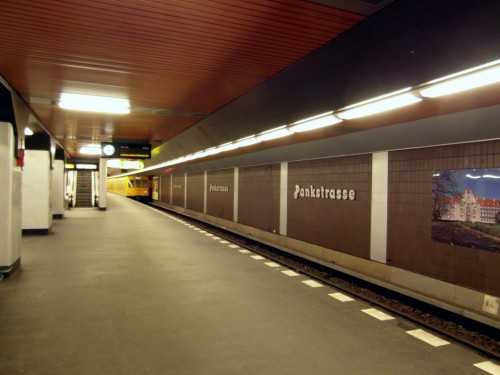 Not much of a homely feel…
All of the bunkers in West Berlin worked on a first-in, first-served basis. Unfortunately those “served” would only make up about 0.8% of the population! After all of this elaborate planning and design, the bunkers were essentially PR placebos for the anxious population. Our tour was run by Berliner Unterwelten, a not-for-profit organisation concerned with preserving Berlin’s underground history. We highly recommend joining them for a tour if you are visiting Berlin.
Berlin’s reputation as a city with an alternative vibe rang true for us. There are lots of cool bars and interesting people walking around. The city’s unique history also makes it a really interesting place to explore and learn about. And, as a bonus, it wasn’t even as cold as we were expecting! We head closer to the equator now, flying into Tel Aviv, Israel – visiting the Middle East for the first time.
Comments from WordPress
-
Lesley 2012-11-06T20:53:47Z
Beautiful photos - the light show must have been amazing. Lxx

Written by Craig Drayton and Sally Robertson